Friday, October 1, 2021

New top story from Time: How Seinfeld Became One of TV’s Great Moneymakers


“People don’t turn down money—it’s what separates us from the animals,” Jerry Seinfeld proclaimed as his character on a 1991 episode of Seinfeld. At that point, Seinfeld himself was making a comfortable $40,000 per episode as the lead of his two-year-old sitcom, which had recently cracked the Top 50 in Nielsen ratings.

Three decades later, Jerry Seinfeld has gotten more chances to turn down money than his character could have ever dreamed of. Seinfeld was a huge hit while on air—earning the comedian $267 million in 1998 alone—and then raked in billions after that year’s finale, first through record-breaking syndication deals, and now as a streaming juggernaut. On Oct. 1, the sitcom arrives on Netflix globally as a part of a five-year deal for reportedly north of $500 million, thanks to both its enduring observational humor and an escalating streaming war in which classic TV shows are being used as crucial weaponry. Here’s how the ’90s sitcom has continued to rake in profitand how it fits into a rapidly shifting television ecosystem.
[time-brightcove not-tgx=”true”]

Doing the opposite
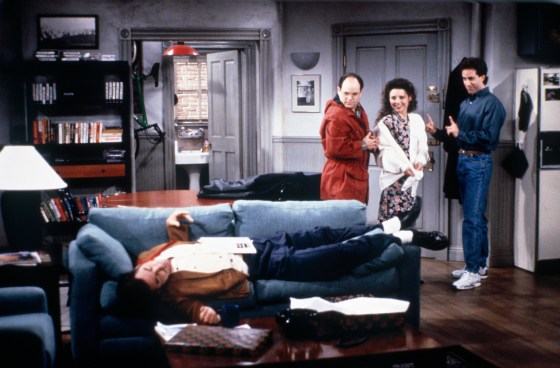
Seinfeld
Maria McCarty/NBCUniversal via Getty Images From left, Michael Richards, Jason Alexander, Julia Louis-Dreyfus and Jerry Seinfeld in “Seinfeld.”

Given that Seinfeld is famously a show about nothing—it mostly depicts four New York City friends sitting around, complaining and undermining each other—it’s not particularly surprising that the show initially struggled to win over audiences and executives alike. The sitcom, which was co-created by Seinfeld and Larry David, premiered on NBC in July 1989—typically a month for networks to dump minor projects—and was only picked up originally for four episodes. The second season received such poor ratings that it was put on hiatus for two months.

But with the beloved Cheers serving as its lead-in, Seinfeld soon caught on to become one of the most popular sitcoms in America. By the show’s ninth and final season, Seinfeld was the number one show on primetime, according to Nielsen, making an estimated $200 million a year for NBC. Jerry Seinfeld was taking in $1 million per episode—a far cry from that early $40,000—and his three main colleagues (Julia Louis-Dreyfus as Elaine, Jason Alexander as George and Michael Richards as Kramer) were pocketing $600,000 per episode. The show’s finale was watched by 76.3 million viewers, nearly matching the ratings for that year’s Super Bowl.

Seinfeld could have easily continued its astonishing run—in fact, NBC offered to raise Seinfeld’s pay from $1 million to $5 million an episode. But he turned the offer down, saying he wanted to focus more on his personal life. (A few years later, Seinfeld would infamously berate Larry King on air for not knowing that his show wasn’t cancelled.)

Double dipping

Over Seinfeld’s run in the ’90s, the television landscape was shifting thanks to the mass adoption of cable. By the end of the decade, almost 80% of American households had access to cable, with channels like HBO and MTV establishing themselves as go-to cultural hubs for more niche audiences. Executives sensed that the era of primetime blockbuster network sitcoms was on the wane, thus rendering the proven hits all the more valuable. In 1998, Turner Broadcasting paid a record sum—over $1 million per episode—to air Seinfeld reruns on TBS. “This may be the last big hit sitcom to come off the networks ever,” TBS President Bill Burke told the New York Times.

Seinfeld reruns continued to earn solid Nielsen ratings. By 2010, the show had earned $2.7 billion in reruns, according to Barry Meyer, chairman of Warner Brothers Entertainment. Usually, syndication deals decrease or end after a show loses cultural relevance—but in 2019, Viacom was still willing to pay an estimated $200,000 to $250,000 per episode for the rights to air the show on cable.

These reruns—which totaled 180 episodes—made many people extremely wealthy, including Donald Trump’s former right-hand man, Steve Bannon, who had worked in the entertainment business for a spell in the ‘90s and earned a stake in the show. “We calculated what it would get us if it made it to syndication,” Bannon told Bloomberg in 2015. “We were wrong by a factor of five.”

But the show’s runaway financial success also caused tension between its stars. In 2003, Louis-Dreyfus, Richards and Alexander refused to participate in the making of a DVD series of the show because they felt they were being taken advantage of. After a standoff, Seinfeld and the producers agreed to cut the trio in on royalties.

Read more: Pour One Out for the Network Comedy

The nexus of the universe

While Seinfeld and David probably would have been comfortable making syndication money for the rest of their lives, the entertainment industry was about to change once again. In the mid-2010s, new streaming platforms invested millions of dollars to create deep libraries to coax subscribers into their folds.

In 2015, following a bidding war with players including Amazon and Yahoo, Sony Pictures Television agreed to a domestic deal reported between $130 and $180 million with Hulu for six years. “I mean, you could just put the DVD in, but I guess no one wanted to do that,” Jerry Seinfeld said at the Hulu upfronts that year during the announcement.

Netflix probably wasn’t too concerned about not having Seinfeld in its catalog, because the streamer dwarfed all others thanks to its first-mover advantage, and its comedy bench was formidable, with viewers able to toggle between The Office, Friends and Cheers. But major film companies, sensing a change in the winds, started to build their own streaming platforms and come for properties to which they owned the original rights. In 2019, WarnerMedia outbid Netflix by shelling out $425 million for Friends to put on a streaming service that didn’t exist yet (now HBO Max). Similarly, NBCUniversal essentially paid themselves $500 million to grab The Office for the gestating platform Peacock.

Seinfeld’s deal with Hulu expired the same year, and given that WarnerMedia partially owned the show, many prognosticators expected the company to highball an offer in order to move it to HBO Max. But Netflix outbid not only them but also Amazon, Viacom and NBCUniversal.

Tim Westcott, a media analyst at OMDIA, says that Netflix shelled out an eye-popping amount of money for Seinfeld for several reasons. “The main reason people subscribe is choice. You have to have a high volume of attractive content in addition to the standout originals, where there’s no guarantee they’re going to be breakout hits,” he says. Comparatively, Seinfeld is a known-property; it’s comforting, broken up into short episodes, and timeless in that its jokes are based on social situations as opposed to historical events.

Seinfeld also has the potential to be a cross-generational draw: it could pique the interest of older, more moneyed subscribers rewatching the show after decades, as well as also a younger generation who is only familiar with the show as a cultural landmark—and might be willing to binge all 180 episodes. In 2018, The Office and Friends were Netflix’s two most-watched shows, with users watching a combined 85 billion minutes, according to Nielsen. A younger generation of viewers, most notably the pop star Billie Eilish, have not been shy about their delight in discovering these long-running classics for the first time.

Netflix’s deal for Seinfeld also helps solidify their relationship with Jerry himself. The platform already had the rights to his roving talk show Comedians in Cars Getting Coffee and had financed two stand-up specials, Jerry Before Seinfeld and 23 Hours to Kill. In June, Seinfeld announced he would be working on a new Netflix movie titled Unfrosted, inspired by a joke he had made about Pop-Tarts.

“This Seinfeld deal might even help lead to future projects with Seinfeld himself, as well as the writers and other talent on the show,” Westcott says. “It’s a good investment for multiple reasons.”

Netflix will need Seinfeld to perform well, because the lead the company had built over its competitors is rapidly closing. Disney+ has accumulated equivalent to more than half of Netflix’s 209 million subscribers despite being available for less than two years, buoyed by mainstream juggernauts like The Mandalorian and Loki. HBO Max is also coming on strong thanks to its deep back catalog of revered TV dramas and blockbuster movies like Godzilla vs. Kong. Second quarter numbers this year for Netflix show that their growth has slowed considerably. Their share of worldwide demand interest, a metric created by Parrot Analytics, fell below 50% for the first time, and they lost 430,000 subscribers in the United States and Canada.

Netflix has also sat on the sidelines as major companies have merged left and right, scrambling to pool money, talent and IP. Discovery merged with WarnerMedia, while Amazon bought Metro-Goldwyn-Mayer. Westcott says that Netflix’s lack of diversification makes them more vulnerable than its competitors. “Studios have other businesses to fall back on: linear channels, theatrical movies, theme parks and licensing. And streaming is a tiny part of the overall Amazon and Apple empires,” he says. “Netflix is slightly vulnerable in that if their streaming business doesn’t keep growing to the extent it has, or if they start losing subscribers, they don’t have another business to fall back on.”

And then there’s the concern that in a rapidly shifting social-media driven world, Seinfeld’s humor could become obsolete. Several critics called Seinfeld’s latest stand-up special out of touch, while many on social media have called attention to Seinfeld‘s racist, sexist or tone-deaf elements. (Conservative outlets, on the other side, have jubilantly scorned these critiques.)

But for now, the situational hilariousness of Seinfeld endures. A Seinfeld parody account on Twitter has 285,000 followers, while pop-up recreations of Seinfeld’s apartment, in which visitors could barge into the room like Kramer, drew lines across the country. There’s a good chance that come Halloween, thanks in part to Netflix’s machinations, countless imitations of Jerry, Eliane, George and Kramer will be running around streets around the world, screaming, “yada, yada, yada.”

New top story from Time: “‘Free At Last?’ Please. Who Is Free?” Choreographer Bill T. Jones Reflects on a Half Century of Creative Work


Bill T. Jones, 69, is a choreographer, MacArthur Genius Fellowship Award winner, two-time Tony award winner, author and cofounder of the Bill T. Jones /Arnie Zane Dance Company. He’s performing with his own company for the first time in 15 years from Sept. 28 to Oct. 9 in a new work, Deep Blue Sea, commissioned by New York City’s Park Avenue Armory. He spoke with TIME about how he stays creative, why he doesn’t like to use the word “dance,” and the how the events of the last 18 months have influenced his art.

You’re still clearly burning to create after many years. How do you keep that fire stoked? When I am moved by a work of art, when I’m moved by a political situation, I immediately begin to think in my language: movement, space and time. So it is still helping me understand how to live. Not to mention that I have a company that must be fed. We’re still fighting for the importance of this art form in public life.
[time-brightcove not-tgx=”true”]

One of the concerns of your new piece, Deep Blue Sea, is “the pursuit of an elusive we.” What does that mean? We the People, we shall overcome, we hold these truths. That is part of everyday parlance, and it’s quite irritating. I am a Black American who truly grew up thinking that we shall overcome, that there was a ‘we’ that transcended ethnicity and race. And the more I have lived, the more I see those things are so deeply entrenched. So what’s this we? This piece is a poem, a metaphorical rendering of wrestling with those stories, using iconographic texts. Herman Melville’s Moby Dick, Chapter 93, and Martin Luther King’s 1963 great March on Washington speech, “I Have a Dream.”

What do those two things have in common? They are iconic texts that define the American sense of our community. Both those documents have grown dusty, taken for granted. And they must be returned to regularly.

This piece was commissioned by the Park Avenue Armory before 2020. Did the racial justice reckoning and pandemic we’ve undergone change the way that you thought about it? Did the piece change? Did I change? I know that I was angry as hell, in a way I haven’t been angry in years. I know that I was and am still struggling with the psychological effects of the recognition that systemic racism and white supremacy is very much the world I have known my whole life. I’ve lived in an apartheid state my whole life. This is the person who was 17 years old at Woodstock dropping acid and saying, ‘We are not our bodies.’ And yet now everywhere I look, I see race. Everywhere I look, now I see identity. I have to police my language, even more than I was doing two years ago. All of those things were made more acute in the environment of the last two years, so it has made the ideas behind the piece more acute.

You did another Armory performance, Afterwardsness, during the pandemic, created within the constraints of social distancing. What did you learn from that experience? The power of gathering. People came and when the first movements began in the music, people wept, people were so moved. That’s power; we take it for granted—we did before COVID. That was a big one to learn. I learned something about myself. How does that assault on our bodies on a biological level, reflect, live with, cohabitate with something like systemic racism? How can they all be happening at the same time? The piece was trying to talk about those paradoxes and contradictions.

Am I right in saying that you have a sort of a special way that you talk with performers and if so, how did you develop it? I’m basically a formalist and formalism demands the isolation of certain elemental languages, symbols, and then their organization and reorganization. Part of the language you see is made from the many dancers who have come through, and they’ve each contributed a shape. And that makes for quite a long laundry list of abstract shapes. Formalism says by combining and recombining them, contextualizing them in terms of what’s being heard, musically, that’s where meaning is found. Can it serve the purpose of entertaining the eye, almost like watching a puzzle. And can it also go deeper than that and connect to languages that are beyond language? These are all questions I’ve been asking my whole artistic life as an adult, something like 40 years now. And every new piece is a challenge. If you see 45 gestures, made independently, strung together with various musicality and rhythms, against a beautiful song, and then the same gestures juxtaposed to a speech about civil rights, are they the same gestures? And I say they are and they are not.

Mark Morris said, “I can be daunting, because I’m scared to death.” Can you relate to that? I can relate very well. I come from field workers, people who understood they are not that far off from the lash. I tried to explain this to my dancers. The young say, “That’s your pathology.” I had young Black people say to me a few years ago, jokingly, but I think they were nudging me, “we need to take a Black power nap.”

Read More: With 1 Final, Amazing ‘September’ Dance Video, Creator Demi Adejuyigbe Explains Why He’s Ending the Beloved Internet Tradition

You’re performing with your own company for the first time in 15 years. Why now? I am probably as much an intellectual speaking presence now as I am a physical dancing presence. But I don’t want to yet give up the fact that the young people in the company and I are bodies together making a body-based art form. It’s hard, but I have to try one more time. Can I sweat with them? Can I learn something? For me. For them.

A decade or so ago, you were you were suffering a little bit from depression. How’s that going? I still have my bouts with it. I think I understand better what it is. And I think I’m up to the challenge. I’m terribly privileged. I’m in love. I have a person who loves me dearly, makes me a wonderful home. I have a lot of reasons to live. And one thing that depression tells you is that you should not. But you have to be vigilant.

It’s no mean feat to keep an experimental dance company going for as many years as you have, especially financially. Do you have a secret? Well, I hardly think of us as a dance company. I have been trying to build an ensemble that can handle movement, text, and music with facility. That’s a goal, building a new contraption, a new company. The clarity of that mission, personally, keeps me on my toes. It’s sometimes extremely daunting, but I know I’m trying to make something new for myself.

How has it been working with the architect who’s designing the set, Liz Diller? It’s an honor to work with her. We’ve gone through Bill’s male ego. I think that there’s a mutual respect that has developed since coming back after COVID. We’ve had our meltdowns and so on. But I think she truly wants to do this piece with me. It’s not naturally where she lives but she actually has seen the way that the world changes. And she’s sort of looking at me with respect. ‘Okay, Bill, where do you want to go?’ And I respect her for that.

There are 90 community members in this performance. Did you teach them to dance? Can we find another word other than dance? Our tradition is body based expression. So you do not have to know how to tendu or turn or stretch or anything, you have to be able to understand physical problems and solve them. You have to be able to get up and in and out of the floor, you have to be able to change modalities of emotional expression. How does anger work? How does pure shape work? There’s a profound meaning in people lowering each other to the ground and helping each other up. The metaphors are there. But they’ve got to understand the technique from inside. Even when it’s not perfect, it is something. We call it milling. And it’s a profound thing to see.

You don’t like to call what you do dance. Why? I feel that dance in the culture is very close to mime. People feel it is an indulgence, something esoteric, or little girls in pink. That’s not what I’m doing. I’m doing a body-based investigation of art-making. You have to find a whole other way to talk about it. It’s not about entertaining you, although it can be. It’s not about getting you sexually aroused, although it can be. It’s trying to really rethink what this basic instrument that we all share is capable of: two arms, two legs. Let’s see, if we get together in a community with clear instructions: What happens?

Read More: ‘Our Stories Are Universal Too.’ Terence Blanchard on Bringing Black Narratives to the Metropolitan Opera

What would the 70-year-old version of you tell the 20-year-old? The world does not care if you want to be an artist. You will always be full of doubt. You will very likely never make a satisfying living. You may get hurt. And yet, it is exhilarating. When it works when you are firing on all cylinders, and there is a population that is leaning in to see, that can be rewarding in a way you can’t imagine.

A lot of your work is very personal. You did a piece about your husband’s mother. You did a piece about your nephew who struggled with addiction. Is that cathartic for you? Or is it because your family is what you find most interesting? Every artist needs some material some spark. I try a lot of things. [These stories] are available to me. There are some things that are always with one. What is available to you that is deep and true? So that personal story: my nephew died last month. He was a very, very sick man when we were making that piece. And the piece was trying to be about an intergenerational conversation. The piece was trying to be about my holding him and saying, your life was not pointless. That personal was at the service of proving something to myself. Once again, what’s worth doing in this world?

A TIME magazine cover in 1994 with your face on it, had the cover line “Black Artists Are Free at Last.” How do you feel about that cover line now? Lord have mercy. To say it hasn’t changed would be wrong. I grew up in a world that I call the white avant-garde. Now that white avant-garde has a lot more color to it. And that’s different. But “free at last?”, please, don’t get me started. Who is free? I am privileged. I have a nice car. Tonight I’ll sleep in a comfortable bed. And I’m working. My house is being renovated. Do I still have pain in my heart about George Floyd? Do I still feel naked and scared in the street? Yes, I do. Voting rights are being rolled back. That’s real. So which world is it? Free at last? Or are we still living in apartheid? Both, I suppose.

Do you mourn the ability to dance as you used to? I do sometimes wish I had that motor I used to have; the impulse to move, the will to move and the ability to move are all one when you’re young. Now it has to be more thought about, which is its own kind of goal.

And do you, when you’re alone, just for the joy, still dance? I dance only when I’m very happy. When I am at a party with a big living room and we’re all having a lovely meal and someone puts on some music that I particularly like, Schubert or something like that. And I let the music course through and it’s heaven. It’s for them. It’s an improvisation; will never be seen again.

This interview has been condensed and edited for clarity.

New top story from Time: Workers Speak Out About Alleged Sexism and Safety Risks at Jeff Bezos’ Rocket Company Blue Origin


A group of more than 20 current and former employees are accusing Jeff Bezos’ Blue Origin rocket ship company of being a toxic work environment and not adhering to proper safety protocols.

The workers claim in an essay that there’s sexism at the Kent, Washington, company. The employees, led by former head of Blue Origin employee communications Alexandra Abrams, state that “numerous senior leaders have been known to be consistently inappropriate with women.” They also claim that many company leaders were “unapproachable” and showed clear bias against women.

There were also safety concerns, with the group stating that Blue Origin seemed more focused on beating billionaires Richard Branson and Elon Musk to space rather than tackling safety issues that would have slowed down the schedule.

Bezos blasted into space on July 21 on the 52nd anniversary of the Apollo 11 moon landing, a date he selected for its historical significance. Bezos held fast to it, even as Virgin Galactic’s Richard Branson pushed up his own flight from New Mexico and beat him to space by nine days.

The group said that last year company leaders seemed impatient with New Shepard rocket’s schedule of a few flights per year, instead wanting more than 40. “Some of us felt that with the resources and staff available, leadership’s race to launch at such a breakneck speed was seriously compromising flight safety,” they said.

Blue Origin said in a statement that it has no tolerance for any kind of harassment or discrimination and that it stands by its safety record. The company said it believes “New Shepard is the safest space vehicle ever designed or built.”

It’s the Season for Cider. Here’s How to Drink It.


By BY REBEKAH PEPPLER from NYT Food https://ift.tt/3l2D04l

A Third Pandemic School Year


By BY LAUREN JACKSON AND SORAYA SHOCKLEY from NYT Podcasts https://ift.tt/2YcSiKU

California plans to add the Covid vaccine as a requirement to attend school as early as next fall.


By BY SHAWN HUBLER from NYT U.S. https://ift.tt/39Z2EQW

The Weekender


By BY JILLIAN RAYFIELD from NYT Briefing https://ift.tt/3mfKss4

I Can’t Stop Making This Dish


By BY EMILY WEINSTEIN from NYT Food https://ift.tt/3B5Cl7F

Thursday, September 30, 2021

A study finds no signs of trouble in getting flu and Covid shots at the same time.


By BY CARL ZIMMER from NYT Health https://ift.tt/3mcFGeU

New top story from Time: Protecting Homes From Wildfire With Aluminum Foil? A Tested Technology Gains Steam


The photo made a splash on social media: General Sherman, the majestic 2,000-year-old Californian sequoia tree with a 36-foot circumference, its craggy trunk shining with silvery aluminum foil wrapped all around it to protect from potential wildfires. Like a baked potato in the oven, commenters said.

California-based Firezat, which is currently the only company in the U.S. that sells this aluminum wrap to public and private entities at scale, has sold thousands of square feet of the material for the express purpose of structural protection against wildfires—including the piece lovingly wrapped around General Sherman. Firezat’s sales increased 30% each of the last two years as fires become increasingly prominent threats to large swathes of both public and private land, with higher temperature, higher wind speeds and longer fire seasons straining firefighting capabilities, says Firezat CEO and founder Daniel Hirning. Five years ago, about 95% of the company’s business was in sales to forest service and Bureau of Land Management customers to protect things like historic buildings; that has expanded to include private homeowners. Hirning says about “several thousand” homes would be able to deploy Firezat by now, based on cumulative sales. Now, other businesses in the space are beginning to see the potential, too. But the buy-in for aluminum wraps, which block 96% of radiant heat, is just in the nascent stages, suggests Hirning. “You think all this coverage and all this advertising exposure [would increase sales even more], but it kind of has the opposite effect,” he says. “There’s an apathy. I think people just get overwhelmed.”
[time-brightcove not-tgx=”true”]

foil wrap wildfires
Gary Kazanjian—APJon Wallace, Operations Section Chief, stands next to General Sherman, a historic tree that is being protected by foil from fires at Sequoia National Park, Calif., Wednesday, Sept. 22, 2021.

The aluminum wrap is an alternative to other go-to fireproofing methods, including fire-resistant gels and foams and water-saturation systems, that homeowners and forest service workers can use to protect structures. Priced at $680 per 1000-square-foot roll, Firezat’s option is a decently cost-effective investment in preventing a total disaster; an average single story home will require about three to four rolls of the stuff, Hirning says, and can be put up in about five or six hours. (It can also be stored and reused annually, and the average time to install the protection should decrease with practice.) A video on the website shows a foil-wrapped log cabin consumed in flames, only to emerge on the other side unscathed, surrounded by trees that look like blackened toothpicks. It’s an impressive case study.

Read More: The World Has Been On Fire for the Past Month. Here’s What It Looks Like

But the effort of wrapping up a house with Firezat ultimately lies with the end user. That’s where the start-up FireGuard hopes to play a role. Founded by civil and hydraulic engineer Shahriar Eftekharzadeh as a subsidiary of SEITec Inc., a science-based company that provides solutions for climate-change-based challenges, FireGuard is mostly a conceptual business right now. Eftekharzadeh’s vision is twofold: for preexisting buildings, his patent-pending “aluminized fiberglass fabric” would descend like protective curtains from a house’s eaves, enveloping the structure within about ten minutes. For new construction, it could be installed as a layer in exterior walls. Both options minimize the need for manual labor—and prioritize time—in the face of imminent fire. “You would know your house is equipped with a fire fighting system, the same as you’d have sprinklers for internal fires,” he says.

For his own cabin in the California woods, Eftekharzadeh has put in place the descending-curtain prototype; luckily, he’s never needed to use it. But it’s the only current example of the brand’s product in action. FireGuard launched a year ago, and has yet to become a priority in marketing; Eftekharzadeh’s primary projects include stormwater-recapture programs and compressed-air energy storage. Still, he sees it as a potentially game-changing option for homeowners—and firefighters. “The other thing we have in mind is that if you make a registry of houses that have this system, then that will really ease the burden on firefighters,” he says.

At other companies that sell aluminum-based radiant barriers commonly used for home insulation, like Texas-based Attic Foil and Innovative Insulation, it’s hard to gauge if the wildfire applications of aluminum wrapping technology have made much of a dent in sales so far, although Attic Foil CEO Ed Fritz did note a recent increase in sales to Californians in particular. But representatives from both confirmed that their materials could be useful in the face of fire—and at Innovative Insulation, their metalized cloth “Temptrol” fabric has even already been used in fire suits.

Read More: The Fight For Earth

As with any consumer product, none of these are 100% effective, says Seth Martin, assistant fire chief and fire marshal for the city of Ketchum, ID. Martin, a longtime firefighter, has plenty of experience wrapping things like forest service lookouts and even campground port-a-potties. It’s labor intensive, he cautions, and needs to be done with precision. “It takes a lot of time and manpower to actually wrap up a structure to the point where you’re fairly confident that it won’t burn,” he says. It can be extremely effective at deflecting heat and keeping embers at bay. But it’s not his go-to suggestion. “The better alternatives are taking mitigation measures ahead of time, and following the defensible space guidelines,” he says. Those include keeping the area around the house clear of potential fire fuel, and landscaping with an eye on fire safety. And those methods are free. “Prepare your house far ahead. Not days, but months, years. You have to start taking steps now to protect your home, before fire threatens,” he says.

As climate change escalates, drought worsens and public resources remain limited, however, sales for Firezat and other startups in the climate damage prevention space keep going up.