(FRANKFURT, Germany) — More than 130 countries have agreed on sweeping changes to how big global companies are taxed, including a 15% minimum corporate rate designed to deter multinationals from stashing profits in low-tax countries.
The deal announced Friday is an attempt to address the ways globalization and digitalization have changed the world economy. It would allow countries to tax some of the earnings of companies located elsewhere that make money through online retailing, web advertising and other activities.
U.S. President Joe Biden has been one of the driving forces behind the agreement as governments around the world seek to boost revenue following the COVID-19 pandemic.
[time-brightcove not-tgx=”true”]
The agreement among 136 countries representing 90% of the global economy was announced by the Paris-based Organization for Cooperation and Economic Development, which hosted the talks that led to it. The OECD said that the minimum tax would reap some $150 billion for governments.
“Today’s agreement represents a once-in-a-generation accomplishment for economic diplomacy,” U.S. Treasury Secretary Janet Yellen said in a statement. She said it would end a “race to the bottom” in which countries outbid each other with lower tax rates.
“Rather than competing on our ability to offer low corporate rates,” she said, “America will now compete on the skills of our workers and our capacity to innovate, which is a race we can win.”
The deal faces several hurdles before it can take effect. U.S. approval of related tax legislation proposed by Biden will be key, especially since the U.S. is home to many of the biggest multinational companies. A rejection by Congress would cast uncertainty over the entire project.
The big U.S. tech companies like Google and Amazon have supported the OECD negotiations. One reason is that countries would agree to withdraw individual digital services taxes they have imposed on them in return for the right to tax a part of their earnings under the global scheme.
That means the companies would deal with just the one international tax regime, not a multitude of different ones depending on the country.
“This accord opens the way to a true tax revolution for the 21st century,” said French Finance Minister Bruno Le Maire. “Finally the digital giants will pay their just share in taxes in the countries — including France — where they produce.”
On Thursday, Ireland announced that it would join the agreement, ditching a low-tax policy that has led companies like Google and Facebook to base their European operations there.
Although the Irish agreement was a step forward for the deal, developing countries have raised objections and Nigeria, Kenya, Pakistan and Sri Lanka have indicated they will not sign up.
Anti-poverty and tax fairness advocates have said the bulk of new revenue would go to wealthier countries and offer less to developing countries that are more dependent on corporate taxes. The G-24 group of developing countries said that without a bigger share of revenue from reallocated profits, the deal would be “sub-optimal” and “not sustainable even in the short run.”
The deal will be taken up by the Group of 20 finance ministers next week, and then by G-20 leaders for final approval at a summit in Rome at the end of October.
Countries would sign up to a diplomatic agreement to implement the tax on companies that have no physical presence in a country but earn profits there, such as through digital services. That provision would affect around 100 global firms.
The second part of the deal, the global minimum of at least 15%, would apply to companies with more than 750 billion euros ($864 billion) in revenue and be passed into domestic law by countries according to model rules developed at the OECD. A top-up provision would mean tax avoided overseas would have to be paid at home. So long as at least the major headquarters countries implement the minimum tax, the deal would have most of its desired effect.
(NEW YORK) — Former President Donald Trump’s company lost more than $70 million on his Washington, D.C., hotel during his four years in office despite taking in millions from foreign governments, according to documents released Friday by a congressional committee investigating his business.
The House Committee on Oversight and Reform said the luxury hotel just a few blocks from the White House was struggling so badly that the Trump Organization had to inject $27 million from other parts of its business and got preferential treatment from a major lender to delay payments on a $170 million loan.
The committee said the losses came despite an estimated $3.7 million in revenue from foreign governments, business that ethics experts say Trump should have refused because it posed conflicts of interest with his role as president.
[time-brightcove not-tgx=”true”]
The Trump Organization said in a statement that the findings of the Democrat-led committee were misleading and false, and it did not receive any special treatment from a lender.
“This report is nothing more than continued political harassment in a desperate attempt to mislead the American public and defame Trump in pursuit of their own agenda,” the company said.
The documents from the committee, the first public disclosure of audited financial statements from the hotel, show steep losses despite a brisk business from lobbyists, businesses and Republican groups while Trump was in office.
The loan delay by Deutsche Bank to the president was an “undisclosed preferential treatment” that should have been reported by the president because the bank has substantial business in the U.S., the committee said in a letter to the General Services Administration, the federal agency overseeing the hotel. The hotel is leased by the federal government to the Trump Organization.
“The documents … raise new and troubling questions about former President Trump’s lease with GSA and the agency’s ability to manage the former president’s conflicts of interest during his term in office when he was effectively on both sides of the contract, as landlord and tenant,” said a statement by the committee’s Democratic co-chairs, Carolyn Maloney of New York and Gerald Connelly of Virginia.
The GSA did not immediately respond to a request for comment.
Trump’s company has been trying to sell the 263-room hotel since the fall of 2019 but has struggled to find buyers during the coronavirus pandemic at a reported initial asking price of more than $500 million.
The head of government ethics watchdog CREW said the losses shed new light on Trump’s refusal to ban foreign governments from patronizing his business.
“The only lifeline was the corrupt business coming from people and organizations and governments seeking to influence him,” said Noah Bookbinder, president of Citizens for Responsibility and Ethics in Washington. “His use of the presidency to get business was absolutely essential to stemming the flow of losses.”
To allay concerns about possibly profiting off foreign governments, Trump promised to send payments to the U.S. Treasury on earnings from his business annually. The payments totaled $356,000 for the first three years of his presidency. Critics of the voluntary deal say Trump’s definition of earnings is unclear and gave the president plenty of room to lowball the figure.
Though the Washington hotel was hurt badly by pandemic-related shutdowns last year, the audited financial statements released by the committee show it was suffering every year it was open before that, too. It lost a nearly $50 million in the first three years of his presidency, then $22 million last year.
If Maria Ressa long has been known to people who follow the news, she has become absolutely essential to anyone grappling with why the news has gotten harder and harder to follow.
Born in Manila and raised in New Jersey, Ressa, who is 58, worked for CNN for years, then in 2012 co-founded Rappler, a vibrant online news site in the Philippines. Four years later an incendiary populist named Rodrigo Duterte was elected President of a country where, a practical matter, Facebook is the Internet. Rappler exposed the hidden hand of his supporters in viral posts, trolls and malign disinformation, as well as the feebleness of Facebook’s efforts to police itself. Since then Ressa has lived at the dangerous intersection of despotism and social media. Arrested, threatened and harassed online, in 2018 she was named a TIME Person of the Year under the heading, “The Guardians and the War on Truth.”
[time-brightcove not-tgx=”true”]
And now Ressa has been awarded the Nobel Prize for Peace, along with Dmitry Muratov, a founder of Novaya Gazeta, an independent Russian newspaper at which six reporters have been murdered. A few hours after getting the news from Oslo, Ressa spoke to TIME by phone from Manila. Her new book, How to Stand Up to a Dictator: The Fight for Our Future, is slated for publication in April.
Moises Saman—Magnum Photos for TIME
Congratulations. What do you think the impact will be of this? When TIME named you a Person of the Year in 2018, you talked about its practical effect in protecting you and your work.
It was a shield. It acted like a shield. And it actually helped us survive because that was December 2018, and my arrests began like two or three months later, and it was going to get worse. Imagine if you hadn’t done that.
That was also when I realized that the only defense we have is to shine the light. And you had given us more battery power, a global megaphone. And that gave us breathing space to keep doing our jobs. It could have been much worse, I think, without.
So what does the Nobel Peace Prize do?
Oh, my gosh, I can’t quite fathom yet. I shouldn’t say this, but I thought it would be [Alexei] Navalny. But it does make sense. The statement they made is exactly the same reason why you did the Guardians in 2018. The platforms that deliver the news are biased against news. And we are being insidiously manipulated. All of that is breaking down trust. Journalists are the target of this.
It’s like we bought into a digital landscape that commoditizes news. So the real news that we do, which takes time and money, is placed in the same setting as the gossip down the street. And the gossip always wins. So it is sugar and vegetables.
This made me realize that it is existential. It is a battle for facts. And we’re at the front line, and it has gotten far more dangerous than it has been in the past. I think that also shows the role of the journalists in fixing this and fixing the mess that we’re in right now.
Where were you when you heard?
I was live in a panel of the independent news groups in Southeast Asia, and they had just come from watching A Thousand Cuts [the Frontline documentary on Ressa]. So we were talking about the survival of independent media in Southeast Asia, and how do we move forward? Right. And in the middle of that, I get a call. And I mean, it just said “Norway.” My God.
I said, “Hold on a second,” and muted and I took the call. And then of course when it was announced, I went from kind of stunned disbelief to like–when I started to talk about why journalism is important, and what we had gone through, that’s when I teared up.
It comes at this strange time for me and Rappler. January is our 10th anniversary. And this shows me exactly how much the world of news has changed since the time we created Rappler, which was about building communities of action, which was built on social media, with the optimism of this technology that could help jump-start development, the dreams that we had. And it worked. It did work all the way until 2016. And then the nightmare. We saw that nightmare. We were plunged into it first. [The populist Rodrigo Duterte became President of the Philippines in June, four months before Donald Trump was elected in the U.S.]
It just shows the role that journalists play because it goes back to without facts, you can’t have truth. Without truth, you can’t have trust. How can you have democracy without that? This is the fabric that holds us together: the shared reality.
I hope that it will give energy at home. Because this is the week where Filipino candidates announce what positions they’re running for. And Bongbong Marcos said he would run for the presidency. And the opposition leader said she would run. So here we are. Think about this: 35 years after the Marcos family was chased out of the Philippines by People Power, the son comes back and is going to run for president. In 2019, we exposed the disinformation networks of Marcos, which even more extensive than Duterte’s. He started his in 2015. And it’s on YouTube, it’s Facebook. How do you change history? You do it through social media. You do it by seeding metadata. It is death by a thousand cuts. It’s historical denialism. We have a lot at stake in the May elections and American social media platforms will play a role in whether we will have integrity of elections.
What changed is I’m also part of the Real Facebook Oversight Board. And yes, we’re still one of two Filipino fact-checking partners of Facebook in the Philippines. But I’m also far more frontal. I think the shift for me happened when I started writing my first book [Seeds of Terror]. I was looking at radicalization, the way the virulent ideology that powered al Qaeda was being transmitted. Like, how were people going to become suicide bombers? So I was looking at information cascades and an individual, the hijacker from 911, behaves very differently when they’re in a group where peer pressure comes in. So this is like the Solomon Asch experiment. Are you familiar with that?
No.
Solomon Asch had this experiment where you have three lines, and there’s six people around the table. The sixth person is the one who is the test case, the five people are actors. And he asked: Name the shortest line, A, B or C. The shortest line is in fact A, and the longest line is C. The five people go before the test subject and name the longest line as the shortest line. And 75% of test subjects will follow the group–75% said the longest line is shortest line despite what their eyes show them.
So the group is different. And when you’re talking social networks and scale, the group exerts pressure on the individual and emergent behavior creates behavior. Which is what social media is doing now. Violence, anger, disinformation is what pumps through this. That’s kind of what Francis Haugen has shown us.
While the Senate is focused on Instagram and the impact on teenagers, what about the impact on journalists? We are being distributed on the same platform that is now being used by autocrats and dictators to actually change behavior with microtargeting. It happens in the dark. I’m much more adamant about legislation. I’ve done the Forum on Democracy and Information. We came out in November last year with 12 structural solutions, 250 tactical ones. I was co-chair with Marietje Schaake. And people like Chris Wiley and Roger McNamee were on it, some of the same people that we also dragged into the Real Facebook Oversight Board.
Since the “cyberlibel” conviction last year, you’ve had to stop traveling abroad. Will you be able to go to Oslo in December?
It’s not a final conviction. But I’ve had four requests that have been turned down. Last December, my mom was diagnosed with cancer, she had a mastectomy and I wanted to be there and court denied it at the last minute. I will put in for travel to Oslo, and I will fight for my right to travel.
Ireland is ready to sign up to a proposed global agreement for a minimum tax on companies, a climbdown that removes one hurdle to an unprecedented deal that would reshape the landscape for multinationals.
On the eve of a key meeting between 140 countries hosted by the Organization for Economic Cooperation and Development, the Irish government said it will join the push for a floor of 15% levied on profits of corporate entities.
“This agreement is a balance between our tax competitiveness and our broader place in the world,” Irish Finance Minister Paschal Donohoe said in a statement Thursday evening announcing the pledge. The decision “will ensure that Ireland is part of the solution in respect to the future international tax framework.”
[time-brightcove not-tgx=”true”]
The rate agreed is 2.5 percentage points higher than the longstanding level that has been a pillar of Ireland’s economic model for a generation, underscoring its huge symbolic significance for a nation whose prosperity is linked to its attractiveness for multinationals seeking an operating base in the European Union.
Ireland’s shift is only one of several awaited from holdouts on a wide-ranging global deal. Several countries are seeking so called carve-outs to partially exempt certain activities from the minimum tax, while others are haggling over a separate part of the talks concerning where profits of big firms are levied.
French Finance Minister Bruno Le Maire says that compromise must be achieved this month on the basis that “it is now or never.” His concern is that without a final agreement at a Group of 20 summit this month, a historic window of opportunity to end years of negotiation will close as chances of U.S. Congressional approval quickly fade thereafter.
While the financial implications of Ireland’s shift may never be realized if the deal isn’t finalized, the importance of the existing 12.5% rate in the national consciousness was the reason a country normally aligned with international consensus held out for so long.
‘At Least 15%’
The Irish government took particular exception to wording in a July draft of the accord that called for a minimum rate of “at least 15%,” a proposal which it didn’t accept due to concerns that the final number could end up significantly higher.
Donohoe repeatedly expressed concern on the “at least” language, which has been dropped from the revised draft and stressed the need for certainty.
“We have secured the removal of ‘at least’ in the OECD text as we had sought,” Donohoe said. “Some countries wanted higher minimum tax rates and I believe our position moderated those ambitions in the context of broader consensus and agreement.
Ireland’s 12.5% rate, which it has held onto since 2003, is well below the average of about 23% throughout the OECD. That’s helped persuade international companies such as Alphabet Inc.’s Google and Facebook Inc. to use it as a base for their European headquarters.
Ireland’s finance ministry estimates it will lose up to 2 billion euros ($2.3 billion) in corporation tax as a result of reforms. Even so, it has argued that its 12.5% rate is only one factor in attracting foreign companies to the country.
—With assistance from William Horobin and Dara Doyle.
This article is part of the The DC Brief, TIME’s politics newsletter. Sign uphereto get stories like this sent to your inbox every weekday.
Mitch McConnell faced two futures. Both featured scorched earth.
One involved a global economic recession that would be triggered if he and his fellow Republicans refused to let the United States pay the government’s bills in the coming weeks. The other wasteland was a Senate without a filibuster where the party in power—notably, not his—could get its way with a simple majority vote.
Given his options, the Republican Leader of the Senate opted to preserve the obstructionist tactic of the filibuster and relented on the borrowing cap—at least for a few weeks. And when the new deadline gets here, he may yet make it painful for Democrats.
[time-brightcove not-tgx=”true”]
The United States faced an Oct. 18 deadline to finish a one-page change to the borrowing limit, known around Washington and Wall Street as the debt ceiling. It’s a vestige of World War I and has routinely been changed by both parties as a routine matter for most of the last century. In fact, the ceiling has been raised 78 separatetimessince 1960.
But starting in 2006, what had been a routine vote for lawmakers started to carry weight. In that year, Democrats—including then-Sen. Joe Biden—used the debt-ceiling vote to lodge an election-year protest against George W. Bush’s tax cuts and heavy military spending. Democrats, it must be noted, did not filibuster and the hike of the artificial limitclearedwith a 52-48 margin. They protested, but didn’t filibuster.
Now, 15 years on, the debt ceiling has trended into the partisan gutter like so much else in D.C. In 2011, the newly elected Republican majority in the House led a revolt that threatened a credit downgrade as both parties fought for the moral high ground on spending. Ultimately, a visibly peeved Obamasigneda deal that reduced deficits by more than $2 trillion over the span of a decade without any new taxes. Two years later, House Republicans forced a government shutdown in an attempt to derail Obamacare and linked the looming mid-shutdown default deadline to it. In that case, McConnell stepped in, dispatched Sen. Lamar Alexander tonegotiatea climb-down for the GOP and the Republicans essentially retreated indefeat.
Now, with Democrats in control of the House, the Senate and the White House, McConnell is trying to extract as big of a political price as possible. For months, he insisted Republicans would force Democrats to use a procedural loophole to pass the debt ceiling with just Democratic votes. Otherwise, they’d have to beat a 60-vote bar to end a filibuster.
Democrats said that they were not going to use the loophole, known as reconciliation and the only thing still giving life to Democrats’ unrelated infrastructure plan. They said they didn’t have enough time to make that work before the looming deadline. And, after all, Democrats had given their support three times during President Donald Trump’s tenure to change the credit card’s breaking point. Once again, Democrats were looking for fair-play from McConnell, the politician who refused to consider Merrick Garland’s nomination to the Supreme Court for a record 293 days.
Early this week, the stand-off appeared to be inching toward doomsday: Oct. 18. Given the enormousimplicationsof a default—six million jobs gone, a 9% unemployment rate and a $15 trillion slash to the stock market, according to Moodys—some Senators started to consider ditching the filibuster to be a real option. If all of the Democrats were in agreement, they could nix the archaic rule that requires three-fifths of the Senate to vote together to end debate on a matter—in other words, a filibuster talk-a-thon meant to jam-up progress.
Progressives have been agitating to get rid of the filibuster, arguing too much of the Democrats’ agenda remains in park because the governing minority can gum it up. So far, institutionalists, including Biden, have resisted such talk, but even the President on Tuesday said dumping the filibuster was “a real possibility.” When even someone so steeped in Senate tradition wavers on the filibuster, it makes even the most stubborn of pols rethink their fortifications.
A day later, McConnell seemed to do the unthinkable, at least from afar. McConnelloffereda temporary extension of the debt ceiling into December, to keep paying the bills already racked up. Sen. Elizabeth Warren said McConnell had“caved,”an assessment that Democrats seemed eager to amplify.
But others were looking around the bend; Sen. MazieHironocalledthe offer “bullshit” and spotted the trap. Because if you look a little closer at McConnell’s exact wording, it becomes very clear that he may just be boiling a bigger tea kettle to the same painful temperature to scald the Democrats. Even in offering a stopgap save, McConnell kept the focus on Democrats’ control; the deal, he said, would “protect the American people from a near-term Democrat-created crisis.”
To be sure, the extension would give Democrats a breather to regroup and to pivot to their infrastructure chase. But it doesn’t change the fact that a long-term extension of the debt ceiling could still elude them. Senior Republicans say they will still force Democrats to use a piece of legislative trickery to raise it come December, something that is complicated, time-consuming and full of fraught votes on political minefields that will never become law. And in doing so, Republicans will force Democrats to put a hard number as their limit on borrowing to comply with the Senate rules on reconciliation. It’s a lot easier to ding a rival for a hard number like $30 trillion than a date, which is how these things usually get scheduled in normal procedure.
McConnell seemed to telegraph that his temporary shift wasn’t a concession that Democrats should necessarily celebrate. By moving the deadline, it “will moot Democrats’ excuses about the time crunch they created and give the unified Democratic government more than enough time to pass stand-alone debt limit legislation through reconciliation,” McConnell said.
In other words: he’s still going to make Democrats go it alone. But when the next deadline hits, it may be on the heels of a massive $3.5 trillion spending plan. And while the current debt ceiling crisis has nothing to do with that effort, it could be tough to separate the two in many voters’ minds. Plus, as an added bonus, the new deadline matches up with a deadline to keep the government’s lights onandthe holiday season. It’s a three-for-one dare that may have Democrats asking Santa for a change in the rules after all.
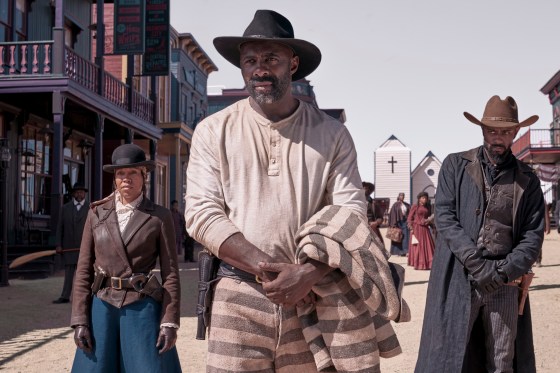
If looking cool were enough to make a movie great, the gritty-stylish revenge Western The Harder They Fall would be the best movie of the year. Everybody, and I mean everybody, looks cool in this thing: Jonathan Majors struts his stuff in a fawn-gold leather jacket as supple as silk. Idris Elba cuts a dashing figure even in workaday prison stripes. Regina King, her withering stare its own brand of don’t-mess-with me glamour, faces down a moving train decked out in an elegant military coat and cap—she’s so fiercely self-possessed you fear more for the poor locomotive than you do for her. Everybody has great hats; everybody, at one time or another, appears on horseback, and everyone looks at home there. If looks—and for that matter, intentions—were everything, The Harder They Fall would be the ultimate.
[time-brightcove not-tgx=”true”]
But even though the plot is simple at its core—rival gangs face off in the old West after a barbarous criminal is released from prison—it too often flies out of the control of director Jeymes Samuel, the writer, director, singer-songwriter and music producer also known as The Bullitt. The movie’s prologue sets up the action: A young boy suffers a traumatic tragedy, and we note, as he does, that one of the criminals has a scorpion tattooed on his hand. Fast-forward a dozen years or so, and that kid, Nat Love (Majors, from Lovecraft Country and Da 5 Bloods), is now grown and avenging the deed that destroyed his family. He has a girlfriend whom he has abandoned but still loves, Stagecoach Mary (Zazie Beetz)—when he returns to her, hat (almost) in hand, she takes him back, but not before laying down the ground rules. She agrees to join him in his quest to take down outlaw gunslinger Rufus Buck (Elba), who has his own loyal, formidable gang to protect him, including his gal, “Treacherous Trudy” Smith (King), and the wise and dignified Cherokee Bill (LaKeith Stanfield). Horses snorting and guns blazing, these dueling groups work through a blood feud where the lines between good guys and bad blur.
David Lee—NetflixRegina King, Idris Elba and LaKeith Stanfield in ‘The Harder They Fall’
The Harder They Fall is fueled by Tarantino-style energy and grim wit, and if nothing else, it’s a spectacle—those glossy, muscular horses, and the gorgeous people riding them, are almost enough to carry a movie by themselves. But this picture works so hard at entertaining us that it strips its own gears; its churning style can’t quite keep the story going. Samuel is also working with so many characters here that not all are drawn as sharply as they might be.
In that sense, the movie’s big selling point—as that rare Western with a nearly all-Black cast—almost becomes a liability. Most of the characters here are drawn from real life. A title card at the beginning states, “While the events of this story are fictional…These. People. Existed.” The Harder They Fall not only introduces us to real human beings whose stories have gone largely untold; it also reclaims the Western genre, historically dominated by white stars like John Wayne and Clint Eastwood, for a new generation of extraordinary actors, period. There are almost too many compelling characters in The Harder They Fall to keep track of, chief among them the scrappy fighter who goes by the name Cuffee (played with flinty, kickboxer elegance by Danielle Deadwyler). Cuffee is modeled on Cathay Williams, the first Black woman to enlist in the United States Army (she did so by posing as a man), and her story is probably enough for a whole movie. The Harder They Fall makes some room for her, but perhaps not enough. It’s one thing to create great opportunities for gifted actors; the harder task is to make sure they’re more than a blur.
In September of 476 AD, the barbarian commander Odoacer forced the teenaged Western Roman emperor Romulus Augustus to resign his office. The Constantinopolitan chronicler Marcellinus Comes would write in the 510s that when “Odoacer, king of the Goths, took control of Rome” the “Western Empire of the Roman people … perished.” But no one thought this at the time. The fall of Rome in 476 is a historical turning point that was invented nearly 50 years later as a pretext for a devastating war. The fact that it has since become recognized as the end of an epoch shows how history can be misused to justify otherwise unpalatable actions in the present—and how that misuse can also distort the lessons future generations take from the past.
[time-brightcove not-tgx=”true”]
Although everyone from schoolchildren to scholars now learn that the Western Roman Empire fell in 476, 5th century Romans did not see anything particularly special about Odoacer’s coup. Nine different Western Roman emperors had risen and fallen since 455 and most of them had been overthrown by barbarian commanders like Odoacer. In four cases, the barbarian generals toppled one emperor and delayed appointing another. One of these imperial vacancies stretched for 20 months, a span longer than the entire reigns of more than 20 previous Roman emperors. Even Romulus Augustus himself was a usurper who assumed the imperial office after an imperfectly executed coup that left Julius Nepos, the legitimate emperor Romulus replaced, still in charge of Western Roman imperial territories in what is now Croatia. In other words, while the West had lost an imperial usurper in 476, it still had a legitimate Roman emperor.
Odoacer maintained most of the structures of the Roman government during the nearly 17 years he controlled the state. The Senate continued to meet in Rome just as it had for nearly a millennium. Latin remained the language of administration. Roman law governed the land. Roman armies continued to fight and win victories on the frontiers. And Roman emperors appeared on the coins that Odoacer minted. These coins showed Julius Nepos at first and then, after Nepos’s death in 480, they featured the busts of the Eastern Roman emperors who reigned in Constantinople.
These aspects of Roman life continued after the Gothic ruler Theoderic overthrew Odoacer in 493. Theoderic proved even more successful than Odoacer in reviving Italian fortunes after the political chaos of the mid-5th century. His armies campaigned successfully in modern Croatia, Serbia and France. He made much of Spain into a protectorate for a time. Large scale repairs were made to churches and public buildings throughout Italy. Either Theoderic or Odoacer undertook renovations to the Colosseum following which senators proudly inscribed their names and offices on their seats.
Rather than imagining that Roman rule had ended in 476, Italians in the late 5th and early 6th centuries spoke about its recovery. Bishop Ennodius of Pavia spoke of the “filth” that Theoderic “washed away from the greater part of Italy,” leaving Rome, as it emerged from “the ashes,” “living again.” Theoderic’s military victories meant that “the Roman empire has returned to its former boundary” and returned “the culture of our ancestors” to Romans who had lived in the regions he reconquered. Ennodius even went so far as to claim that “the revival of Roman renown brought Theoderic forward” as a rival to Alexander the Great because he had sparked a Roman “Golden Age.”
How did it happen that Odoacer’s coup, the beginning of this Roman resurgence, instead came to be seen as the fall of Rome? The answer lies not in Italy but in Constantinople. As Italian power returned under Odoacer and Theoderic, relations with the Eastern Roman Empire in Constantinople deteriorated. By the time of Theoderic’s death in 526, Romans in Constantinople had begun considering the possibility of invading Italy.
It is at this moment of East-West tension that we can return to Marcellinus Comes. Marcellinus’sChronicleappeared in the late 510s and represents the first historical work known to claim that Rome fell in 476. Marcellinus’s text also gives away why he said this. Marcellinus describes Odoacer as “the king of the Goths” when he caused the Roman Empire to “perish.” This is a fabrication. Odoacer was not a Goth. Theoderic, however, was a Gothic king and he had taken power from Odoacer. As the Gothic-led Western Roman state found itself in increasing tension with Constantinople, the fall of Rome emerged as a way to justify an Eastern Roman invasion that would restore Italy to Eastern Roman control.
Marcellinus did not invent this idea in a vacuum. He served in Constantinople as an aide to the future Eastern Roman emperor Justinian, who was at the time the imperial heir apparent. Marcellinus later received several honorific titles from Justinian following the publication of hisChronicle, a work that bluntly hammers home its main theme that the Western Empire had fallen and Justinian’s Eastern Roman Empire should restore it.
This propaganda worked well. In 535, Eastern Roman armies attacked Italy. Justinian explained this aggression by claiming that “the Goths have used force to take Italy, which was ours, and have refused to give it back.” His troops entered the city of Rome in December of 536. On this day, Justinian’s official historian Procopius wrote, “Rome became subject to the Romans again after a time of 60 years.” The number 60 was not arbitrarily chosen. The capture of Rome by the East came 60 years and three months after Odoacer’s coup of 476.
Despite these initial successes, Justinian’s armies struggled to consolidate control over the peninsula. The Italian war did not conclude until 562 and the fighting devastated both the city of Rome and much of Italy. Goths recaptured Rome in 546, lost it in 547, retook it in 549, and then lost the city for good in 552. Residents of Rome survived by eating weeds, mice and dung during a long Gothic siege in 546. It is estimated that Rome’s population fell from perhaps 500,000 in the mid-5th century to as little as 25,000 in the 560s. Other Italian cities suffered even worse fates. Milan, once Italy’s second largest city, was razed to the ground in 539 with its entire population either killed or enslaved. The Eastern Roman Empire had recovered Italy—and destroyed much of it in the process.
The Western Roman Empire had clearly fallen by the 560s. Italy was controlled by Justinian, many of its cities were ruined and much of its infrastructure was severely damaged. When later historians looked for the moment when the Western Empire fell, they found Marcellinus and his claim that Rome fell under Odoacer. In the memorable framing by the historian Brian Croke, the fall of Rome in 476 is a manufactured historical turning point that has become an accepted historical fact. But it was Justinian’s invasion, not Odoacer’s coup that decimated Italy and ended the Western Roman state. For 1,500 years, we have picked the wrong time and blamed the wrong person for the fall of Rome.
This mistake matters for two reasons. First, Marcellinus’s manufactured fall of Rome helped create conditions that permitted Justinian to launch a war that killed hundreds of thousands and destroyed the prosperity that Roman rule had once created in the West. His words had real, deadly and long-lasting consequences.
Second, the manufactured fall of Rome reveals the unstable boundaries between historical epochs. For 1,500 years, Odoacer’s coup has concluded a cautionary tale about how barbarian commanders in the Roman army ended Rome’s empire. People around the world have scrutinized this story so that their societies may avoid suffering Rome’s fate. But, if we recognize that Rome did not fall in 476, the lessons we take from Roman history become quite different. Rome’s story then does not warn us of the danger of barbarous outsiders toppling a society from within. It instead shows how a false claim that a nation has perished can help cause the very problems its author invented. We ignore this danger at our peril.
The Biden administration is temporarily relaxing the rules for a student loan forgiveness program that has been criticized for its notoriously complex requirements—a change that could offer debt relief to thousands of teachers, social workers, military members and other public servants.
The Education Department said Wednesday it will drop some of the toughest requirements around Public Service Loan Forgiveness, a program that was launched in 2007 to steer more college graduates into public service but, since then, has helped just 5,500 borrowers get their loans erased.
Congress created the program as a reward for college students who go into public service. As long as they made 10 years of payments on their federal student loans, the program promised to erase the remainder.
[time-brightcove not-tgx=”true”]
But more than 90% of applicants have been rejected. After making a decade of payments, many borrowers have found that they have the wrong type of federal loan or repayment plan to be eligible for the program. Thousands have ended up stuck with debt they thought would be cleared.
Under the temporary changes, those borrowers will now be eligible to get their loans erased.
Through October 2022, borrowers who have worked 10 years in a qualifying job will be eligible for loan relief no matter what kind of federal loan or repayment plan they have. Past loan payments that were previously ineligible will now count, moving some borrowers closer to the finish line.
The change will immediately make 22,000 borrowers eligible to get loans canceled, and another 27,000 could become eligible if they get previous payments certified, according to the department. In total, more than 550,000 borrowers will be moved closer to forgiveness, the agency said.
“Borrowers who devote a decade of their lives to public service should be able to rely on the promise of Public Service Loan Forgiveness,” Education Secretary Miguel Cardona said. “The system has not delivered on that promise to date, but that is about to change for many borrowers.”
It’s a particular boon for borrowers with Federal Family Education Loans, from a defunct loan program that issued federally backed loans through banks. Loans in that program, which ended in 2010, were previously ineligible but can now be cancelled through the updated rules.
Among other changes, the department will allow military members to count time on active duty toward the 10 years, even if they put a pause on making their payments during that time.
And starting next year, the department will automatically count payments by federal workers and military members toward the required 10 years. Under existing rules, applicants have to apply to get their payments certified.
The changes are seen as a short-term fix while the agency considers permanent improvements through a federal rulemaking process. The department started holding hearings this week as part of a process that could bring sweeping change to federal student aid programs, including the public service benefit.
Advocacy groups praised the temporary changes. Aaron Ament, president of the legal group Student Defense, which has represented students in lawsuits over the program, called it a “huge step in the right direction.”
Randi Weingarten, president of the American Federation of Teachers, said the change is welcome.
“Today we breathe a collective sigh of relief as the Kafkaesque system that dashed the dreams of far too many finally starts to be dismantled,” she said.
The program has been a source of bipartisan scorn — Democrats and Republicans have agreed that the program is flawed and needs to be updated. But Republicans said the Education Department is overstepping its authority by moving to alter a program that Congress created.
Rep. Virginia Foxx, R-N.C., the top Republican on the House education committee, said President Joe Biden’s administration is “circumventing Congress through executive action.”
“We agree this program is in desperate need of reform; however, such reforms require Congressional action, and we encourage you to work with us to fix the federal loan and repayment program,” Foxx said in a letter to Cardona.
It marks the latest of several attempts to fix the program. In 2018, Congress set aside $700 million to temporarily expand the benefit to all types of loans and payment programs, but after a year, most applications were still being denied.
A report from the Government Accountability Office found that President Donald Trump’s administration had created a “confusing and inefficient” process that often disqualified borrowers for rules they were never told about.
In June, a report from the Education Department drew attention to the program’s shortcomings saying it “has spawned much confusion and frustration” while forgiving loans for just 5,500 borrowers.
In 2021, reggaeton sits at the center of global pop music. Bad Bunny wasSpotify’s most-streamed artistof last year, while artists like J Balvin, Farruko and Karol G rack up hundreds of millions of YouTube views a month. With its booming beats and brash lyrical flows, the genre connotes glamour, sex and tropical bliss; it’s the soundtrack to nightclubs across the world.
But reggaeton, with its working class roots, anti-government impulses and strained relationship with the major label system, is so much more than party music. These oft overlooked aspects have been at the center of Loud, a 10-episode Spotify podcast which began airing in August.“The real story of reggaeton is aboutla resistencia. Resistance,” the podcast’s host Ivy Queen, herself a major reggaeton star, says in the first episode. “About how kids who were young or poor, Black or dark-skinned—kids who were discriminated against in every way—how we refused to be quiet.”
[time-brightcove not-tgx=”true”]
The joy and defiance ofLoud, combined with its rich historical details and impressive access to first-person sources, make it one of the best podcasts of the year. On Wednesday, the podcast’s final dropped on Spotify. Here are the main takeaways from the season.
The complex origins of reggaeton
While reggaeton is most strongly associated with 21st century Puerto Rico,Loudstarts its history of reggaeton in an unlikely setting: 1904 Panama. That year, the U.S. entered that country in order to build a canal that would connect Atlantic and Pacific trade routes. To build the canal, the U.S. imported workers from across the West Indies, including Jamaica and Barbados, making Panama City a multilingual, multicultural melting pot.
In the 1980s, descendants of those original Black workers started to bring dancehall—an updated version of Jamaican reggae—into Panamanian sound system parties. Performers like Renato soon found that if they spoke to the predominantly Spanish-speaking audience in their language as opposed to English or Patois, the crowd would go crazy. They began translating Jamaican dancehall songs, Trinidadian soca and other Afro-Antillean genres into Spanish. A new tradition of singing Spanish flows over Jamaican rhythms was born.
ButLoudargues that as the genre became more commercial, its Black roots were pushed to the background—and that colorism still runs rampant in the genre. “Black reggae become [sic] Spanish reggae and white reggae,” the artist Reggae Sam says in one episode. “They eliminate all the negritos … It become a business and it was stolen.”
Homophobia and sexism have long been rampant in reggaeton lyrics and are ingrained in the genre’s foundational rhythm: dembow, which has been utilized by the majority of popular reggaeton songs (Daddy Yankee’s “Gasolina,” for example.) In 1990, the drum pattern was popularized by “Dem Bow,” a song by the Jamaican reggae artistShabba Ranksin which he disparages men who have oral sex. A couple years later, Ranks said thatgay people should be crucified; he has since apologized.
Anti-policing messages
Much like hip-hop in the United States, early reggaeton was often created by artists to protest the unfair treatment of Black people at the hands of the police. One of the first major reggaeton records, Renato’s 1985 “El D.E.N.I.,” told stories of police brutality in Panama City. “You sing this music because it’s the only way that black poor struggling people can protest and fight against the government,” Reggae Sam says in Loud‘s first episode.
This theme would continue when the genre moved to Puerto Rico in the ’90s. At the time, San Juan was a major drug hub, with dealers using the city as an entry point to smuggle drugs into the United States. In episode four, the artist Nicky Jam talks about how it was often the drug dealers who fronted the money for musical projects in lieu of record labels, intertwining the genre’s development with illegal activity.
This connection made reggaeton artists a target when Puerto Rican Governor Pedro Rosselló began an aggressive crackdown against crime in the 90s known as “Mano Dura” (Iron Fist). Ivy Queen describes the National Guard rolling into public housing like an occupying army, breaking down doors and searching apartments with assault weapons. And police also targeted reggaeton artists, regularly raiding record stores and nightclubs. One music video director, Hector “El Flaco” Figueroa, recounts a story of having to throw out dozens of his music video tapes into the pool during a raid. In response to this incident and many others, reggaeton artists wrote many anti-police anthems during this era, including Ivy Queen’s “Somos Raperos Pero No Delicuentes.”
Daddy Yankee’s rise to the top
While Daddy Yankee is one of the most recognizable stars in reggaeton history—still racking up 36 million monthly listeners on Spotify—Loud explores another artist who was just as big in the early 2000s, but has since been overshadowed: Tego Calderón. “In 2004, Tego was that guy,” Ivy Queen says in episode six.
ButLoudreveals how over the next year, two instances of Daddy Yankee’s rising success would come directly at the expense of Calderón’s. The first was when Daddy Yankee replaced Calderón on the New York rapper N.O.R.E.’s hit “Oye Mi Canto,” which helped bring the genre to African-American audiences. The second was over a marketing opportunity: initially P. Diddy wanted Calderón to be the face of a new major fashion campaign. But Calderón refused, partially because of alleged human rights violations at clothing factories the companies used in Central America, and partially because he says he felt disrespected by what he perceived to be a lowball offer.
“I don’t need a billboard. I am not trying to conquer white Middle America. I already won the hearts and respect of those I wanted to win—mi gente Latina, my people, the street, my black brothers and sisters,” Calderóntold the New York Postin 2005.
So in his place, Daddy Yankee stepped into the Sean John campaign, introducing his face to countless people around the country. That year, his song “Gasolina” took the world by storm, sending American record labels scrambling to replicate his look and sound.
How Miami became the modern center of reggaeton
Over the decades, the center of reggaeton has shifted from one global city to another: Panama City in the ’80s, Brooklyn and San Juan in the ’90s, Medellín in the ’00s. Now, Ivy Queen says that the center of reggaeton is in Miami, where many artists reside—including herself, Maluma and Daddy Yankee—as well as labels, radio stations and production studios.
But in the show’s final episode, Ivy Queen worries that the robust money-making infrastructure built in Miami—with its glitzy studios and group writing sessions—threatens what initially made the music so special.“Are we going to lose the soul of this music if we keep making it more and more commercial?” she asks. “Will people remember where it came from? Can it stay true to its roots—su raices—in the hood as Black music, as rebel music? What’s going to happen if we don’t tell our story?”
While appearing before the Senate Commerce subcommittee on Tuesday, Facebook whistleblower Frances Haugen, a former Facebook project manager who revealed her identity on 60 Minutes on Sunday, testified that the social media site’s products “harm children, stoke division and weaken our democracy,” and that congressional intervention is needed.
The hearing came in the wake of Haugen leaking tens of thousands of pages of company documents to senators showing that Facebook has failed to fix numerous problems that it’s long known about, and in some cases made them worse. The documents became the subject of a series of articles in theWall StreetJournalin September that detailed internal Facebook research and alleged that Instagram is “toxic” to teens’, and specifically teen girls’, mental health.
[time-brightcove not-tgx=”true”]
Following Democratic Sen. Richard Blumenthal opening the hearing by stating that Facebook, and Big Tech as a whole, is facing a “Big Tobacco moment,” Haugen repeatedly spoke to allegations that “Facebook is prioritizing profit over people.”
Comparisons were made between the ways in which Facebook and tobacco are both addictive and profitable, but ultimately unhealthy for users. Blumenthal also referenced the tobacco’s industry’s history of hiding its own research on the harmful impact of its products in connection to Haugen’s allegations against Facebook.
Eating disorder content from Instagram’s algorithm
Although Facebook announced on Sept. 27 that it was pausing the development of an Instagram for kids under 13 amid public backlash, Haugen testified that the company knows that Instagram causes “severe harm” to children and teens.
Haugen said Facebook claims that it can’t find underage kids on the platform because they lie about their age when they sign up, but testified to senators that is false. She stated that Facebook could employ the mechanisms it uses to analyze other types of audiences on the platform but just chooses not to do so.
In response to a question about how Instagram’s algorithm plays a role in making body image issues worse for teens, Haugen said that Facebook has confirmed that Instagram users can be led by the algorithm to eating disorder content. Remedying the effects of negative social comparison that teens experience while using the platform will require larger measures than just removing “likes,” she said.
Haugen also detailed how Facebook’s algorithm’s heavy weighting of “meaningful social interactions,” i.e. content that generates strong reactions, has resulted in a system that’s amplified divisive content on the platform, fostered hate speech and misinformation, and incited violence, including recent ethnic violence in Ethiopia.
‘Facebook should not get a free pass’
Haugen spoke at length about how “Facebook can change, but is clearly not going to do so on its own,” imploring the legislators to act.
She went on to urge senators to overhaul Section 230, which shields digital platforms from lawsuits over content posted by their users, specifically suggesting that Facebook and other tech giants be made legally liable for decisions about how to rank content in users’ feeds.
“They have a hundred percent control over their algorithms, and Facebook should not get a free pass on choices it makes to prioritize growth and virality and reactiveness over public safety,” she said.
Haugen argued that Facebook could still be profitable if it changed its methods of amplification, such as by switching to a chronological ranking system rather than engagement-based, to eliminate the problematic aspects of its algorithm. She also proposed the development of a regulatory body that could synthesize requests for data that are privacy conscious so that Facebook can no longer stonewall its internal findings.
Holding Facebook accountable
Senators said they supported issuing subpoenas to get the full text of the internal Facebook research leaked by Hogan that the company previously refused to release. There was bipartisan agreement on this point, with senators from both parties speaking to the need for congress to take action to better understand what’s happening at Facebook.
“I think we’re going to look back 20 years from now and all of us are going to be like, ‘What the hell were we thinking,’ when we recognize the damage that [Facebook] has done to a generation,” Republican Sen. Dan Sullivan said.
“Our children are the ones who are victims,” Blumenthal added. “Teens today looking in the mirror feel doubt and insecurity. Mark Zuckerberg ought to be looking at himself in the mirror.”
President Thomas Jefferson in 1806wrote a letterto English physician Edward Jenner. Ten years earlier, Jenner had intentionally infected a boy with cowpox, in order to protect him against the much more terrifying smallpox disease. It worked. Jenner gathered more evidence, and two years later he published hisInquiry into the Variolae vaccinae known as the Cow Pox. News traveled across the Atlantic, and Jefferson was among the first Americans to recognize the revolutionary potential of vaccination. He praised Jenner in lavish terms: “Medicine has never before produced any single improvement of such utility.” In fact, Jefferson foresaw an end to a disease that was then the most deadly and most feared affliction in much of the world. “Future nations will know by history only that the loathsome small-pox has existed and by you has been extirpated.”
[time-brightcove not-tgx=”true”]
Jefferson was visionary—but too optimistic. Mortality from smallpox declined precipitously as vaccination spread, but progress stalled and at times reversed in the late 19th century. Even at the beginning of the 20th century, there were still thousands of cases of smallpox a year in the United States, and not until the late 1920s was the disease completely eradicated from the country. Globally, progress was even more halting. A massive global health crusade in the 1960s and 1970s finally realized Jefferson’s vision of rendering the disease a thing of the past. The last naturally occurring case of smallpox occurred in 1977—171 years after Jefferson’s letter to Jenner imagined a world without the disease.
The example of smallpox elimination is one of many that reminds us the control of infectious disease requires both technical and social adaptations. Jenner’s discovery of vaccination ranks as one of the greatest scientific achievements of all time. But technical solutions on their own are never enough. In the U.S., the spread of vaccination required an effective communication campaign, cultural acceptance of vaccines and, above all, changes in the nature and power of the state. Namely, the rise of public health boards, and their ability to mandate vaccination, were necessary to bring the disease completely to heel domestically.
The COVID-19 pandemic has been a painful reminder that confronting the challenge of infectious disease requires both science and social adaptation. The development of multiple safe and highly effective vaccines against COVID-19 in under a year is a marvelous accomplishment. And yet the combination of vaccine hesitancy at home, and vaccine inequity abroad, has let the pandemic surge anew and linger, with no end in sight. Before COVID-19, the U.S. was ranked high on pandemic preparedness. And yet our response has been an embarrassment and a tragedy—as well as a detailed map of our weaknesses, which our nation’s enemies are sure to be tracking in detail. Our science was ready, but our society was not.
As a historian of infectious disease, who expected that we would face a destabilizing pandemic in our lifetime, I do not find this pattern surprising. But it is concerning that we are not absorbing the lesson. Last month, the Biden Administration released apreviewof its future pandemic preparedness plan. The vision is admirably bold. It proposes a $65 billion investment over 10 years that will be managed “with the seriousness of purpose, commitment, and accountability of an Apollo Program.” The plan is motivated by the sober reality that another pandemic is inevitable. Indeed, as the plan states, “There will be an increasing frequency of natural—and possibly human-made—biological threats in the years ahead.” And, as it notes, the next one might well be worse. COVID-19 is a severe and deadly disease, but there is plenty of opportunity for a new pathogen that is equally contagious yet more virulent.
President Joe Biden’s proposed strategy offers much to like. It promises to make major investments in critical areas where we do not do nearly enough, from surveillance and early-warning systems to real-time tracking of viral evolution. It outlines a path towards even more rapid vaccine development and deployment, as well as fundamental improvements in the treatment of viral diseases. It proposes basic improvements in public health infrastructure domestically and globally.
The problem, however, is that nearly all of the agenda focuses on technical solutions. There are only modest hints of an effort to understand how societies respond to the challenge of pandemics and how we can work to make ourselves more resilient. The plan calls for “evidence-based public health communications,” which is laudable, but otherwise there is nothing that matches its scientific aspirations with an equally ambitious call to prepare our society to handle the next threat with greater cohesion and strength. So, two cheers for the Apollo-like vision. But pandemic preparedness is a categorically different project than getting to the moon, because success depends on the behavior of more than 300 million Americans and 8 billion people globally.
It is a disheartening fact that the experience of COVID-19 has rendered our society less ready for the future challenges. The tribalization of our response to masking, vaccines and other mitigation measures has been swift and extreme, and this represents a serious obstacle to preparedness. The reality is that public health is always political. But it is not always bitterly partisan, especially in a polarized society. If anything, we have taken a step backward. Compulsory vaccination, for example, allowed us to conquer smallpox and other menacing diseases, and it became part of our constitutional order and social fabric. In 1905, when a man from Massachusetts protested against a vaccine mandate, saying the requirement violated his individual liberty, the Supreme Court ruled 7-2 that mandatory vaccination was within the power of the states. The majority opinion held that “there are manifold restraints to which every person is necessarily subject for the common good…” On any other basis, organized society could not exist with safety to its members.” Some of the constitutional particularities have changed, but the fundamental issues have not. We are relitigating our sense of the common good, at a time when divisiveness and mistrust are at high tide.
The sooner we grapple with that reality, the better prepared we will be. Evidence-based public health communication is a start, but it is far from adequate. A fully-fledged plan should establish an R&D agenda that draws from the social sciences and humanities; it should put in place the framework, resources and incentives to drive forward our knowledge of the determinants of successful public health initiatives. There is a huge amount of ongoing research that is trying to help us understand why countries (and even states) have responded to COVID-19 so differently. It is already evident what a complex question this presents, involving both apparently fixable variables like good leadership, but also much deeper, historically-rooted cultural factors. A plan to build resilience will have to confront the tensions between individualistic values and social cohesion, the decline of public trust in institutions, the poison of polarization, the role of social media in shaping attitudes toward health and medicine, and the structural inequalities that have been so apparent throughout the pandemic. In short, we need a bold, coherent agenda to advance our understanding of the human side of the equation.
The Biden strategy as proposed earns an A on the technical front, but unless its shortcomings are redressed, it will fail on its social-behavioral agenda. We know all too well how that combination has worked – both throughout history and in our present moment.